dlt-proof-writing is an Agent Skill (for Claude Code, or any Anthropic-Agent-Skills-compatible runtime) that automates the bookkeeping side of writing a proof in deep-learning theory. Writing a proof splits roughly in two: finding the structure and picking the assumptions on one side; drawing the dependency graph, looking up citations, getting the format consistent, running lint, doing the read-through-twice-and-fix pass on the other. The skill takes the second half. I keep the first.
It targets proofs in optimization, learning theory, statistical rates, fine-grained complexity, and RL regret.
Open source under CC BY-NC 4.0. Source: github.com/ChristianYang37/DLT-Proof-Writing-Skill.
A worked example: test-time scaling for thinking LLMs
The companion post, Reasoning as Optimization, works through a specific result I produced using this skill. The question is a piece of an active research conversation: when an o1- or R1-style LLM spends more compute on “thinking”, what is the mechanistic rate at which accuracy improves?
I drafted the proof end-to-end with dlt-proof-writing. The output is a 20-page PDF carrying three theorems, two corollaries, seven lemmas, and a discussion section on empirical scope. Here’s the page with the main result:
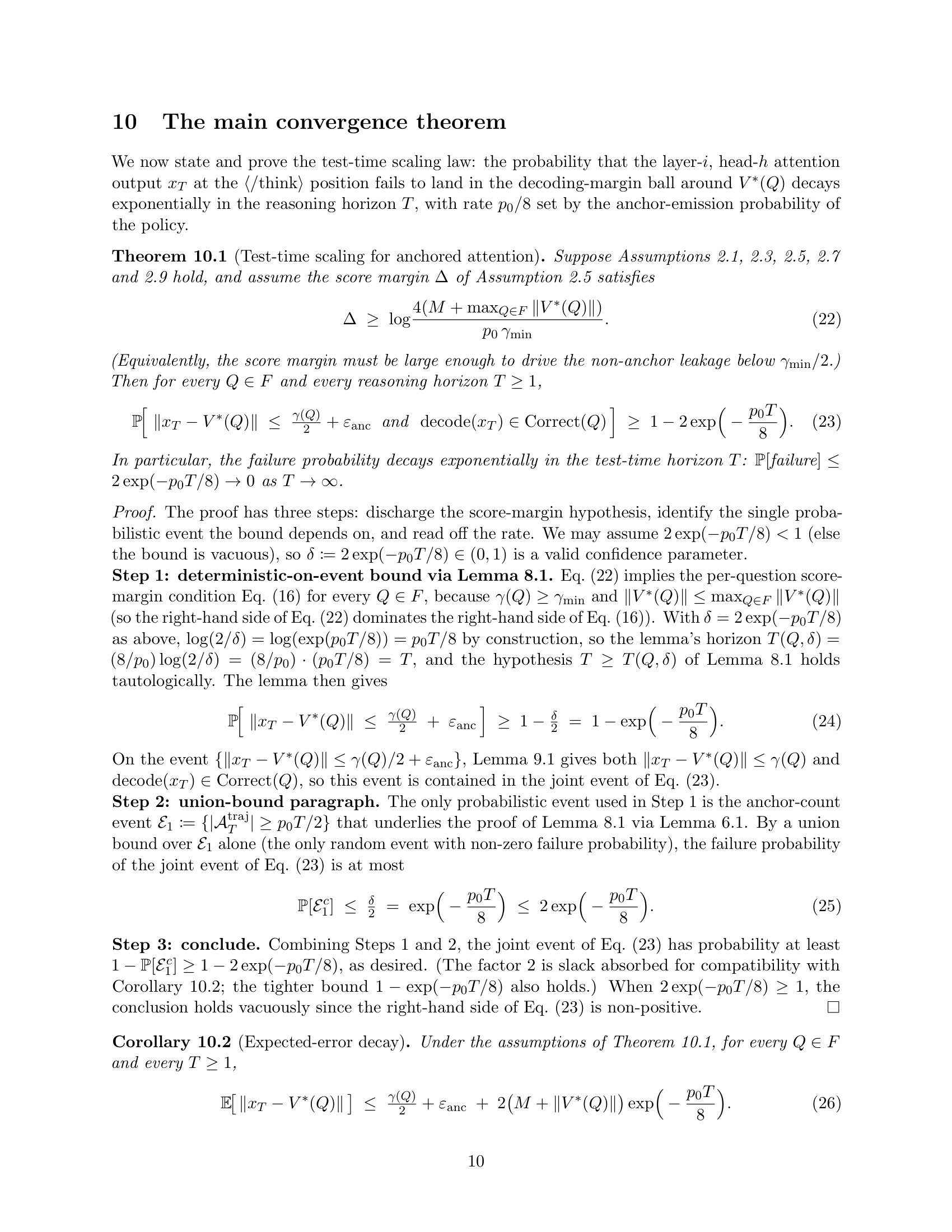
Under five inference-time-observable assumptions on the LLM’s reasoning policy, the failure probability of the thinking process decays exponentially in the reasoning horizon $T$ at a rate determined by the anchor-emission probability $p_0$:
$$\Pr[\text{failure}] \;\le\; 2 \exp\!\Bigl(-\frac{p_0\, T}{8}\Bigr).$$A two-line tail-to-expectation argument gives the expected-error corollary:
$$\mathbb{E}\bigl[\|x_T - V^*(Q)\|\bigr] \;\le\; \tfrac{\gamma(Q)}{2} + \varepsilon_{\mathrm{anc}} + 2(M + \|V^*(Q)\|)\,\exp\!\Bigl(-\frac{p_0\, T}{8}\Bigr).$$The proof goes further. A second corollary translates the running-average convergence into next-token-entropy decay (matching the plateau Choi et al. 2025 document empirically); a separate theorem in a “discussion” section gives a lower bound showing the $\exp(-p_0 T)$ rate is tight up to a constant in the exponent; and a third theorem in another section shows that under a stronger unbiasedness hypothesis on anchor values, the floor itself decays as $\sigma/\sqrt{p_0 T}$ — i.e., accuracy scales with $T$, not just confidence:
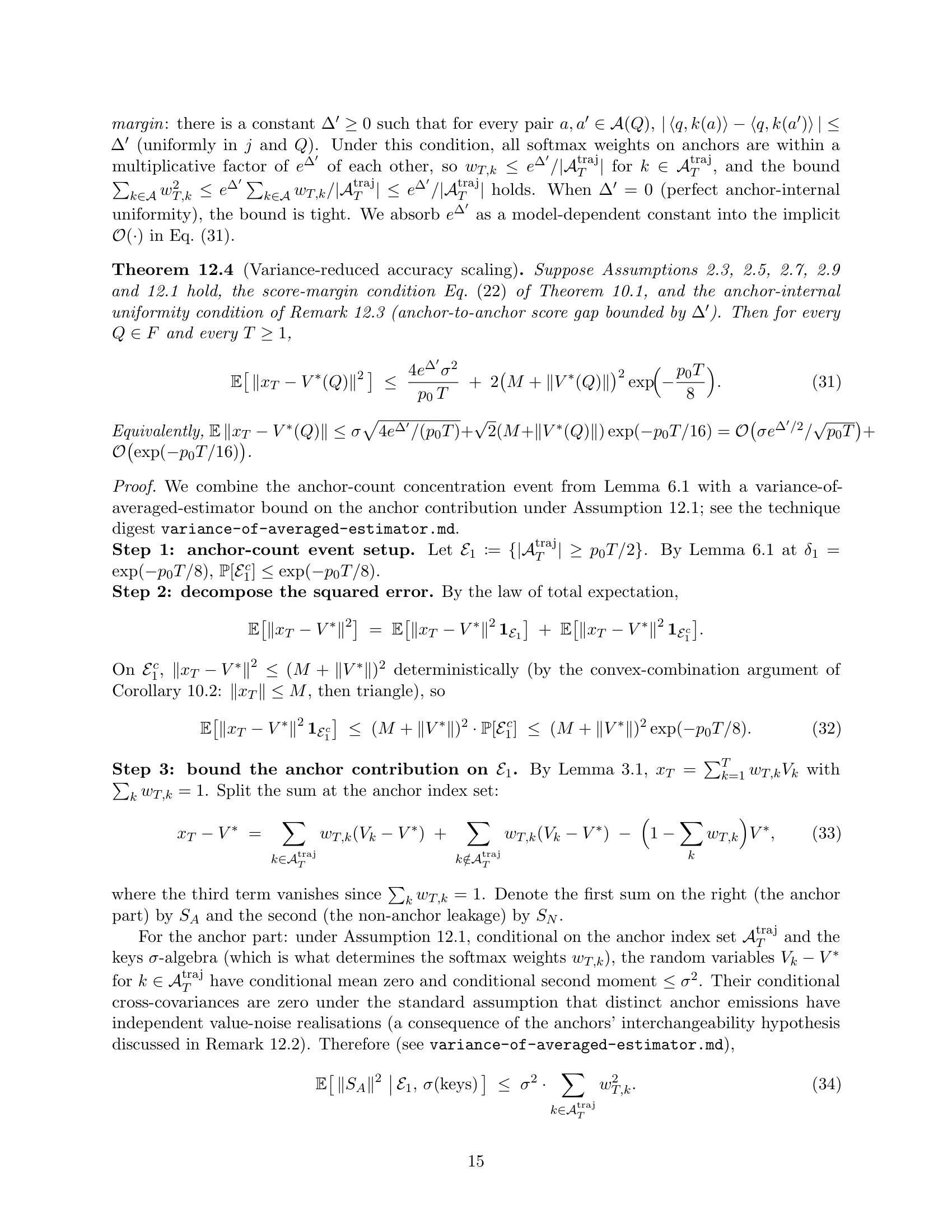
All .tex sources, the dependency graph, citation digests, technique digests, the confidence trace, and five iterations of self-review live in eval_results/08-reasoning-as-optimization/. The compiled PDF is here (20 pages).
What this gets me: the structure-finding and assumption-picking happen in conversation; everything else — bibliography, lemma scaffolding, lint, five rounds of self-review — happens by the skill’s own pipeline. Total time I spend on bookkeeping is effectively zero.
The four-phase workflow
The skill enforces a sequence the agent cannot skip:
Phase A — Plan. Read the project, declare scope (Quick / Standard / Appendix) and have
check_scope.pyverify the declaration is not understated, enumerate the non-trivial techniques the proof will need, write a.proof-research/<technique>.mddigest for each, pick organizational patterns from a catalogue, decompose the goal into a dependency graph of named lemmas. Any lemma without a downstream consumer gets deleted before drafting starts. There is no “we’ll use it later” exception.Phase B — Preliminaries. Notation, definitions, assumptions. Each assumption is followed by exactly one
\begin{remark}discussing its mildness and weakenability. The discussion goes into the remark; the assumption stays clean.Phase C — Statements and proofs. Topological order, leaves first. Per-statement review (a seven-item checklist). Per-proof review (a nine-item checklist; the third item is the silent-bug favourite — does the cited lemma’s hypothesis actually hold at the cite-site?). One section per
.texfile. Incremental lint after every write.Phase C.5 — Confidence sweep. I tag every derivation step 🔴
from-memoryby default. The author agent walks the flat list and upgrades each step via a fast path (textbook inequality / digest match / project-lemma match) or by firing a verifier sub-agent that re-derives the step in the background. Whatever is still 🔴 at the end carries a\todo{verify}marker so the Phase D reviewer focuses on the right places.Phase D — End-to-end review. Three scripted gates each have to exit 0 (compile, lint, confidence coverage). A bounded peer-review loop spawns a reviewer sub-agent; each weakness gets classified as REAL-blocking / REAL-nonblocking / PHANTOM / INTENTIONAL; minimum-change fixes apply; the loop converges or hits a 3-round cap.
Each phase boundary is gated by an exit code or a script verdict, not by the agent’s own judgement.
Three design choices
The triple Phase-D gate. Three checks I would do manually before showing a draft to a collaborator, run automatically. latexmk-wrapper.py ensures the document compiles. lint.py enforces formatting and citation hygiene. check_confidence_tags.py confirms every derivation step has been annotated with its confidence level, with at least 50% trace coverage. Any one of them returning non-zero blocks the review loop. The hour of mechanical re-reading I would otherwise spend before sending out a draft is what gets automated here.
Mechanical honesty triggers. Every time I’ve written a proof and gone back to check citations and constants, I’ve found at least one place where the cited lemma’s hypothesis didn’t quite hold at the cite-site, or where I introduced a constant without saying what it depended on. The lint rules check those automatically:
- Writing
\cite{key}without a matching.proof-research/cite-<key>-*.mddigest fires R13. - Invoking matrix Bernstein or Hanson-Wright without
.proof-research/<technique>.mdfires R14. - Introducing a bare
$C$without the universal-constant declaration fires R15. - A case-split that says “the other case is similar” when the cases use different machinery fires R16.
- Stating a
1-\deltaconclusion without an explicit union-bound paragraph fires R17. - Putting any theorem or proof environment inside
main.texitself fires R18.
These are pre-conditions to “I’m done”. The bookkeeping bugs that used to take a careful re-read to find now block the workflow at lint.
Confidence sweep with fire-and-forget verifier sub-agents. When I write a proof by hand, I carry a rough map of which steps I am certain about and which I would re-derive before submitting. The confidence sweep externalises that map. Every derivation step starts tagged 🔴 by default, and the agent upgrades each step either by matching to a digest in the technique catalogue or by spawning a verifier sub-agent that re-derives the step independently. The author keeps writing; verifiers run in the background. Whatever survives 🔴 through the sweep gets surfaced to the Phase D reviewer with a pointer.
Eval coverage
I validated the skill on seven calibration benchmarks: five in-scope DLT proofs (Hoeffding’s inequality, NTK two-layer convergence, VC generalization bound, LSVI-UCB regret on a Linear MDP, Sobolev minimax lower bound) and two out-of-DLT generalization probes (the Ellenberg–Gijswijt cap-set bound, the Gilmer union-closed bound via entropy). All 70 assertions pass under the full workflow.
The two probes are where the signal lives. Slice rank and entropy methods sit in a different mathematical neighbourhood from NTK and Polyak-Łojasiewicz, and the gates apply the same way. The discipline carries.
Getting started
Plugin install:
/plugin marketplace add ChristianYang37/DLT-Proof-Writing-Skill
/plugin install dlt-proof-writing@DLT-Proof-Writing-Skill
Manual install (symlink; edits to the source repo take effect immediately):
git clone https://github.com/ChristianYang37/DLT-Proof-Writing-Skill.git
cd DLT-Proof-Writing-Skill
make install
A reusable XML-tagged prompt template lives in the README. Fill <problem> with the formal statement; leave <approach>, <proof_structure>, <target_theorems> blank when you want the skill to propose them. The blank-handling protocol stops the agent at the end of Phase A so you sign off on the approach before any LaTeX gets drafted.
Cite as:
@misc{dlt-proof-writing-skill,
  author       = {Yang, Chiwun},
  title        = {{DLT} {P}roof {W}riting {S}kill: an {A}gent {S}kill for rigorous deep-learning-theory proof drafting in {L}a{T}e{X}},
  year         = {2026},
  howpublished = {GitHub: \url{https://github.com/ChristianYang37/DLT-Proof-Writing-Skill}},
  note         = {Licensed under CC BY-NC 4.0}
}
← Back to Blog 1: Reasoning as Optimization